FAQs
- Mentorship and business education
- Marketing support and exposure
- Technical assistance and consulting
- Collaborative opportunities with other entrepreneurs
- A strong network of downtown partners and existing businesses
- Staffing and onsite management
- Utilities and building maintenance
- Tenant recruitment, leasing, and support
- Programming, events, and marketing
- Required reporting and performance tracking
- Clear accountability
- Clean and separate bookkeeping
- Transparent financial reporting
- Effective long‑term program oversight
Why is the Town investing in a retail incubator?
Increasing downtown vibrancy is a long‑standing Town Council priority and attracting locally owned retail has been a persistent challenge. Opening a traditional storefront requires significant capital, long‑term leases, and ongoing operating costs, barriers that often prevent promising entrepreneurs from taking the risk.
The Local @414 is designed to lower those barriers. The incubator model provides affordable physical space paired with hands‑on support, giving early‑stage businesses the chance to test and grow their concepts in a more accessible, lower‑risk environment. Tenants will have access to:
Retail cooperatives and incubators are proven tools in communities across the country. They provide flexible space under one roof and accelerate business development by offering low‑cost leases, technical support services, mentorship networks, supportive marketing and events, and access to capital during the critical early years.
The Town is committed to empowering aspiring and growing retailers by offering both affordable space and a robust network of business support services, helping create an environment where all entrepreneurs have the opportunity to thrive.
How did the Town decide to use ARPA funds for The Local? Was there public input?
The Town’s decision to allocate ARPA funds to support the redevelopment of 414 North Main was shaped by extensive public participation. Residents provided feedback through the Town’s Let’s Talk platform, during public meetings, and throughout capital planning discussions. The incubator was also covered in local media, and the lease itself was presented at a public hearing, giving the community multiple opportunities to review the proposal and offer comments before funding was finalized.
In addition to this public input, the project’s design and program structure have been developed by an advisory committee made up of existing downtown business owners, business‑development nonprofits, Town staff, and others. This group ensures the incubator reflects local needs and is grounded in the experience of people who work directly with small businesses in Blacksburg.
Who is managing The Local?
The Local will be managed through a partnership model that prioritizes community benefit, transparency, and strong operational oversight.
Downtown Blacksburg Inc. (DBI) will operate the incubator.
DBI is a 501(c)(6) nonprofit organization specifically designed to promote a “common business interest”, in this case, strengthening the business environment in downtown Blacksburg. This mission aligns directly with supporting small‑business development, making DBI well‑suited to manage a retail incubator.
As part of its role, DBI will handle the day‑to‑day operations of The Local, including:
DBI will also organize local events to increase traffic to retail businesses, work with local economic development partners like the Montgomery County Chamber of Commerce, the Blacksburg Partnership, and the Small Business Development Center to meet the technical assistance needs of incubator participants, and help participants access capital through their relationships with local financial institutions.
DBI’s offices will be located inside the building to ensure efficient oversight and strong daily support for tenants.
A dedicated LLC will manage The Local’s finances and reporting.
To ensure full transparency and clear separation from DBI’s other programs, DBI is establishing a stand‑alone LLC for The Local. All incubator‑related income, expenses, and outcomes will flow through this LLC. This structure is considered a best practice because it provides:
It also allows the Town, DBI, and the public to easily monitor how incubator resources are used and how the program is performing over time.
The Town maintains ownership and oversight.
The Town of Blacksburg leases the building to DBI for $1—a deliberate policy choice that prioritizes community value over profit.
Operating costs, including utilities, insurance, janitorial services, and phone/internet, are paid by Downtown Blacksburg Inc. (DBI). DBI funds these expenses using revenue generated from Tenant rent, Event and meeting space bookings, Pop‑up retail leases and Café lease income.
While the Town is providing limited support during the initial start‑up phase, the long‑term model is designed for the incubator to become self‑sustaining once programming is fully built out and the space reaches stable occupancy. Under this structure, DBI covers all day‑to‑day operational costs, and the Town retains ownership of a community‑serving amenity that activates a key downtown space, supports local entrepreneurs, and contributes to broader economic development.
This approach ensures that The Local @414 delivers strong public value while operating responsibly and independently over time.
A proven model of partnership.
This structure mirrors partnerships the Town already uses successfully, such as the Blacksburg Farmers Market, where the Town provides the facility at a nominal rate and a nonprofit partner manages operations. These models create vibrant spaces, support local business growth, and produce strong returns for the community.
What will The Local look Like?
Lets Take a Tour of the Space.
Enter off Main Street into the welcome area, retail stalls, then to bathrooms, conference, room, and offices.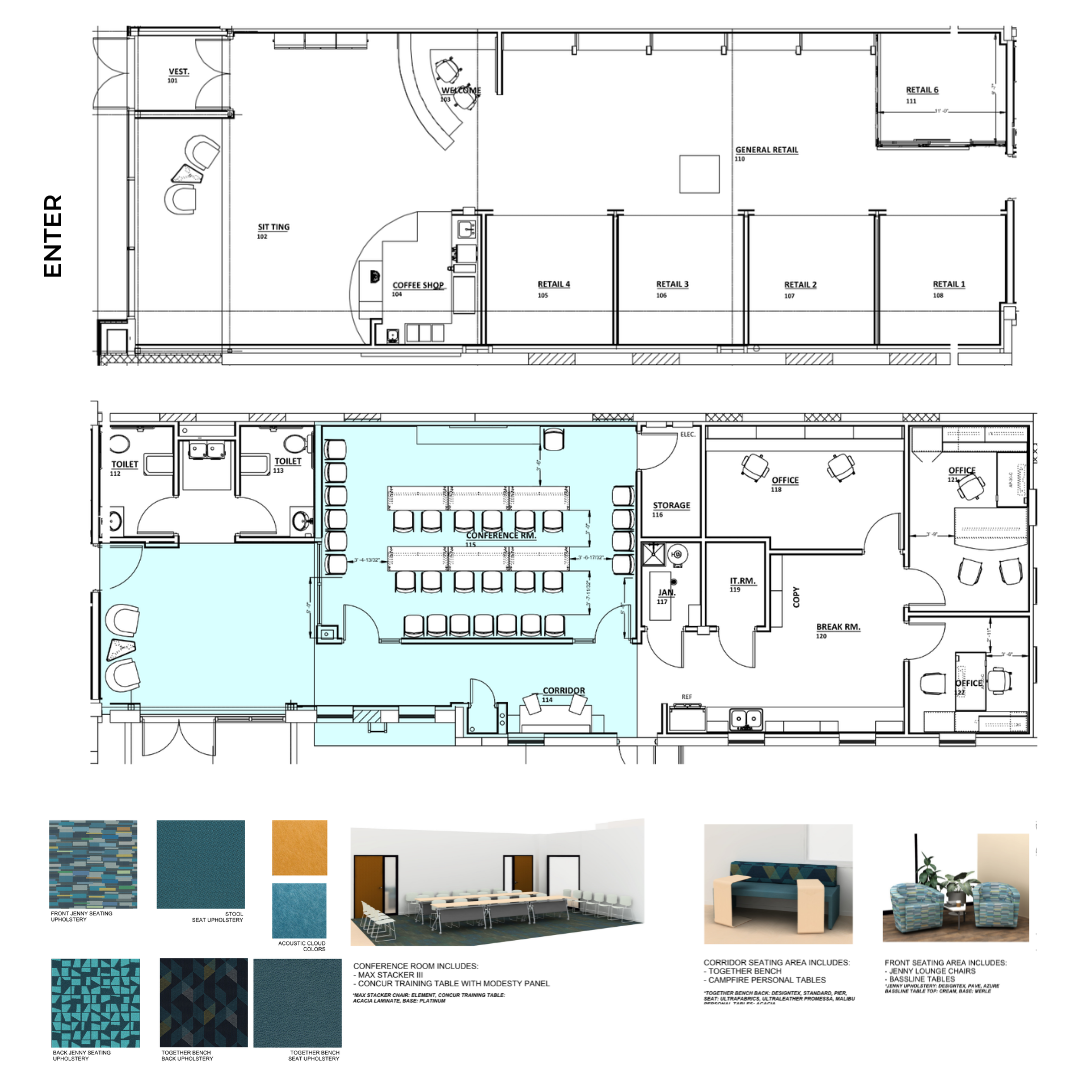
How are businesses selected, and how is tenant oversight handled?
Every applicant goes through a structured, multi‑step review process led by an Advisory Committee that includes DBI leadership, educators, business owners, Town representatives, and over time, tenant representatives. Applicants must submit a full application package including a business plan, financial documents, product descriptions, branding and marketing strategies, and proof of eligibility to operate a business.
The goal is to select businesses that bring something new to downtown, show strong potential for growth, and are ready to engage with customers and the community. Only applicants who meet these standards advance to an interview, and only those who demonstrate fit and readiness are offered a lease.
Oversight has been built into both the Town’s Master Lease and the incubator’s internal structure. The Master Lease requires regular reporting to the Town and includes a 60‑day cure and termination clause if DBI or the Town fails to meet a major obligation.
Internally, tenants must submit monthly or quarterly financial statements, sales reports, inventory documentation, and business performance summaries. The Local Manager and Advisory Committee will review this information to ensure tenants stay on track. If a business is struggling, staff will work closely with them to develop a performance improvement plan. If issues persist, the lease may not be renewed.
This oversight model aims to balance support with accountability, ensuring that public resources generate real results and that The Local @414 remains a strong, effective launchpad for small businesses.
What is the History of 414 N. Main St.?
The property was originally constructed in 1920 and operated as a dry-cleaning business from about 1947 to 2014. The Town purchased the 414 N. Main Street property in January 2015 to resolve an inverse condemnation claim filed by the previous owner. The claim arose after changes made during the North Main Street Improvement Project altered parking access for the building. These changes were necessary to improve traffic safety, as cars backed directly into North Main Street traffic, creating a hazard.
The property had environmental contamination from its past use as a dry cleaner. Environmental studies identified dry-cleaning solvents, primarily tetrachloroethene (PCE) and trichloroethene (TCE), in the soil, groundwater, and soil vapor at levels above those allowed by the Virginia Department of Environmental Quality (VA DEQ). Cleanup costs would likely have been too high for a private owner to undertake, so the Town secured state grant funding to remediate the site. By taking on this work, the Town ensured the property could be safely reused.
To specifically address these findings, the Town enrolled the property in the VA DEQ’s Voluntary Remediation Program (VRP) to work cooperatively with VA DEQ to identify contamination and clean up the property to standards appropriate for its planned public use, in compliance with all applicable federal, state, and local environmental regulations. Compliance was achieved on January 14, 2025 when the VA DEQ issued a Certification of Satisfactory Completion of Remediation after reviewing all cleanup activities.
Because of its prominent location at the gateway to downtown Blacksburg and Virginia Tech, the Town ultimately chose to preserve the site for community benefit rather than risk it remaining vacant or underused. The Local retail incubator is intended to activate this important property, support local entrepreneurs, and create a welcoming and vibrant entry point into downtown.